Kowloon Shopping Guide: Nathan Road Zone by Zone
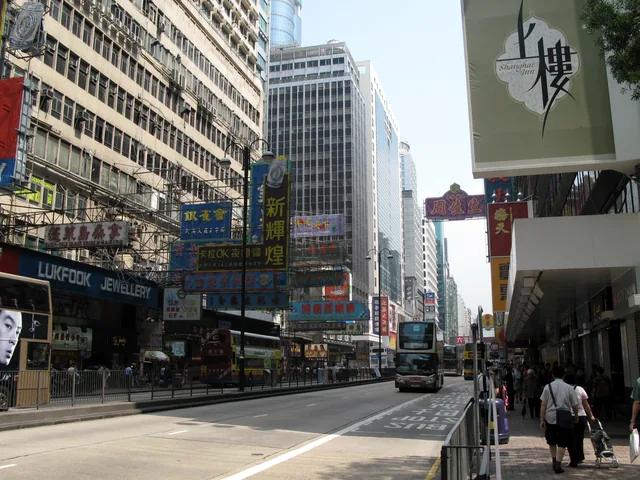
HK Nathan Road Mong Kok Section.jpg — WiNG, CC BY 3.0, via Wikimedia Commons (https://commons.wikimedia.org/wiki/File:HK_Nathan_Road_Mong_Kok_Section.jpg)
Nathan Road is the spine of Kowloon shopping. It runs about 3.6 km from its southern end at Salisbury Road in Tsim Sha Tsui – a few metres from Victoria Harbour – north to Boundary Street, and the Tsuen Wan and Kwun Tong lines run directly underneath it, putting five MTR stations on the road itself: Tsim Sha Tsui, Jordan, Yau Ma Tei, Mong Kok and Prince Edward.
That single line of track is what makes the corridor work as one shopping trip. The southern zones are malls, flagship stores and arcades. The northern zones are street markets. The three stops between Tsim Sha Tsui and Mong Kok do not just move you up a road; they cross from fixed, ticketed prices into prices you negotiate.
This guide is the zone-by-zone version of that trip: which zone to shop in for what, what things cost in each, and how to hop the MTR between them without spending the day on the pavement. For the shops themselves, our Nathan Road shopping guide covers what sits where; this page is the decision layer above it.
The corridor at a glance
| Zone | MTR station | What it is for | How prices work |
|---|---|---|---|
| Tsim Sha Tsui (south) | Tsim Sha Tsui | Malls, flagship brands, department stores, arcades, the big hotels | Fixed and ticketed |
| Jordan | Jordan | Local shops, opticians, drugstores and restaurants; the southern approach to the night market | Mostly fixed |
| Yau Ma Tei | Yau Ma Tei | Jade Market, traditional shops, and Temple Street Night Market after dark | Bargained at both, harder on Temple Street |
| Mong Kok | Mong Kok | Ladies' Market, Sneaker Street, the Goldfish Market, and one large mall of its own | Haggled at the stalls |
| Prince Edward – Boundary Street (north) | Prince Edward | Residential and practical; the northern end of the corridor | Fixed |
🧭 The short answer
Malls, brands and department stores: shop Tsim Sha Tsui, at the harbour end.
Street markets and real bargains: shop Mong Kok, three MTR stops north.
Between them sit Jordan and Yau Ma Tei – local, generally cheaper, and home to the night market. Ride the Tsuen Wan Line one stop at a time and walk each zone rather than trying to cover all 3.6 km on foot in one go.
One piece of local vocabulary is worth keeping. The southern stretch through Tsim Sha Tsui was nicknamed the Golden Mile in the post-war years, when it was the address for shopping in Kowloon. The name has largely fallen out of use – it survives mainly in the Holiday Inn Golden Mile hotel – but you will still hear it from taxi drivers and hotel concierges, and it always means the same stretch of road.
Zone 1: Tsim Sha Tsui – the mall end
The southern kilometre is where the corridor is at its most vertical. Tsim Sha Tsui MTR station sits under the road, iSQUARE opens straight onto it, and the rest are within a short walk – which matters more than it sounds on a wet afternoon or in August.
iSQUARE at 63 Nathan Road is the one to know: a 31-storey tower with roughly 600,000 sq ft of shops across more than 140 shops, and it was the first shopping and entertainment complex in Hong Kong with a direct pedestrian link to Tsim Sha Tsui MTR station. Its five cinemas, seating about 1,000 between them, are on level 7 – useful if you are waiting out a rainstorm with a shopping bag.
The ONE at 100 Nathan Road gives you 29 floors over roughly 400,000 sq ft, opened in 2010 on the site of the former Tung Ying Building. Its 16th-floor Sky Garden is the reason to ride to the top even if you buy nothing.
Mira Place, opposite Kowloon Park, is the mid-market bridge between the luxury arcades and the street: more than 150 shops and around 40 restaurants and cafes, and the easiest of the TST malls to combine with a walk in the park. The Kowloon Masjid and Islamic Centre stands on the road beside the park on the same stretch.
On the harbour side, a few minutes off the road itself, sit two more of the reasons people shop Tsim Sha Tsui at all: K11 MUSEA at Victoria Dockside on Salisbury Road – opened in 2019, more than 250 stores, and open daily from 10am to 10pm – and Harbour City, which sprawls along Canton Road and will take a whole afternoon on its own if you let it.
💡 Tsim Sha Tsui in practice
Prices here are set by the brand, not by you. Nothing in this zone is haggled. What you get for the fixed price is air-conditioning, English-speaking staff, warranties, returns policies and stock you can actually find in your size. If you are buying something you need to be genuine, or something you may need to return, this is the end of the road to do it on.
Zone 2: Jordan and Yau Ma Tei – the local middle
Two stops north the character changes. Around Jordan MTR the shops are working shops: opticians, drugstores, phone and electronics dealers, tailors, and the upper floors of the buildings above them holding offices, clinics and small restaurants. This is where residents buy daily necessities, and prices for everyday goods sit below Tsim Sha Tsui.
Yau Ma Tei is the transition zone, and it holds two very different shopping experiences. By day the Jade Market sells jade and jewellery from undercover stalls. It is open to a haggle – though far less theatrical than Temple Street – and a reasonable place to learn what jade actually looks like before spending real money elsewhere. After dark, the same neighbourhood becomes the corridor's night market: Temple Street trades daily from roughly 2pm to 11pm, is free to walk, and mixes clothing and souvenir stalls with street food, fortune tellers and Cantonese opera singers.
At the Yau Ma Tei end of the market, the Tin Hau Temple gives the street its bearings: Temple Street is named for the temple it runs past.
Zone 3: Mong Kok – where the prices come down
Mong Kok is the reason most people ride the corridor at all. Three stops from Tsim Sha Tsui, and the shopping switches from a mall you enter to a street you walk down.
Ladies' Market (女人街) runs about a kilometre of stalls along Tung Choi Street between Argyle Street and Dundas Street – more than 100 of them, selling clothing, bags, accessories, phone cases, souvenirs and toys. It opens around midday and trades until roughly 11pm, and the street is closed to vehicles from 4pm Monday to Saturday and from noon on Sundays and public holidays, which is when it is at its fullest. Getting there from Nathan Road takes a few minutes from Mong Kok MTR station.
Sneaker Street is Fa Yuen Street, a couple of blocks east, where the southern end between Dundas and Argyle Streets packs in more than fifty sports-shoe shops – a trade that has been on this street since the 1980s. It is also where the discounting is: current-season models at retail, and the older colourways cut hard.
Two smaller markets complete the district. The Goldfish Market continues up Tung Choi Street north of Bute Street, shop after shop of fish in oxygen bags, tanks and accessories, and the Flower Market and Bird Market sit a few minutes further north-west, which is why an afternoon in Mong Kok so often ends up being three markets rather than one.
And the mall exception: Langham Place at 8 Argyle Street is the area's biggest mall, with more than 200 shops over 15 storeys and an 83-metre escalator that skips a good part of them. Mong Kok MTR Exit C3 connects directly into its basement; Exit E1 arrives at ground level beside it. The contrast is the point – you can walk out of the escalator hall into a haggled market street in about two minutes.
🎯 Mong Kok in practice
Walk the street once before you buy anything. The same scarf, magnet or phone case is sold at several stalls and the opening quotes differ. Then decide your number before you ask, and start at 40–50% of the price you are quoted.
Mall prices vs street-market prices
The two ends of Nathan Road are not just different shopping, they are different price systems. In the malls, the price is the price. At the market stalls, the first number is an opening negotiation. That difference is worth more than the difference in the goods.
The table below puts the two side by side. The street-market column is built on our Ladies' Market benchmarks in Mong Kok – what you should expect to settle at, after bargaining, checked against Hong Kong travel sources in October 2026 – treat them as the number to aim for rather than a quoted price list, because a street market has none.
| What you are buying | Mall / chain store (Tsim Sha Tsui) | Street market (Mong Kok – Ladies' Market benchmarks) |
|---|---|---|
| Souvenir magnets, keychains | Gift-shop price, fixed | HK$10–30 |
| Small souvenirs | Gift-shop price, fixed | HK$20–80 |
| T-shirt, plain | Chain-store price, fixed | HK$30–80 |
| T-shirt, Hong Kong-themed | Chain-store price, fixed | HK$60–100 (quoted around HK$150) |
| Dress | Brand price, fixed | HK$80–300 |
| Silk scarf | Brand price, fixed | HK$100–200 |
| Handbag, unbranded | Brand price, fixed | HK$150–200 (quoted around HK$500) |
| Chopstick sets, wooden and engraved | Gift-shop price, fixed | HK$80–200 |
| Qipao / cheongsam, ready-made | Tailor or brand price, fixed | HK$200–600 |
| Branded trainers | Brand retail – current-season pricing | Superseded colourways discounted, typically 20–40% below mall retail |
Two things follow from that table. First, for a branded item, the mall is not necessarily dearer – it is the same brand price everywhere, and the shopping advantage of Mong Kok is the outlet end of the market, where last season's stock is cut hard. Second, for anything unbranded, the gap between the two zones can be several times the price, and none of it is advertised anywhere except on the stall.
⚠️ Counterfeits, and a tax fact worth knowing
Mong Kok's market streets are known for counterfeit goods – fake designer handbags, replica watches and look-alike headphones. These are copies sold as copies, quality is typically low, and carrying counterfeit branded goods across a border carries legal risk. If the brand name matters to you, buy it in the mall; the fixed price buys you the real thing.
On the other side of the ledger, Hong Kong has no sales tax, VAT or GST, and no tourist tax-refund scheme, because there is nothing to refund. The tag price is what you pay, in either zone. Expecting a tax rebate at the airport is the most common shopping misconception visitors arrive with.
The MTR hop: TST → Jordan → Yau Ma Tei → Mong Kok
The corridor is designed for hopping. The Tsuen Wan Line runs beneath Nathan Road and stops at all five stations on the road in order, so each leg of the shopping trip is a single stop. Get on, get off, shop, get back on – that is the whole system, and it is why the sensible plan is one zone per session rather than a forced march.
| Leg | Stations | What you land in |
|---|---|---|
| Starting point | Tsim Sha Tsui | Malls, flagship stores, the harbour, the Golden Mile |
| 1 stop north | Jordan | Local shops, opticians, drugstores; the southern approach to Temple Street |
| 2 stops north | Yau Ma Tei | Jade Market by day, Temple Street Night Market by night |
| 3 stops north | Mong Kok | Ladies' Market, Sneaker Street, Goldfish Market, Langham Place |
| 4 stops north | Prince Edward | Boundary Street and the residential end of the corridor |
Which exits matter: at Mong Kok, Exit E2 puts you on Nelson Street, a couple of blocks from both Ladies' Market and Fa Yuen Street; Exit D3 brings you along Argyle Street to the market; and Exit C3 goes straight into the basement of Langham Place. At the other end of the corridor, follow the signs for Tsim Sha Tsui exits onto Nathan Road itself.
💳 Fares and payment
MTR fares are distance-based, so rather than print a number that will date, check the current price for your exact station pair on the MTR fare page. An Octopus card is the simplest way to move around, and it is the payment method you will want in the malls anyway. On the market streets, bring cash in HK$10, HK$20 and HK$50 notes.
If you would rather walk part of it, the road is 3.6 km end to end – roughly three-quarters of an hour at a steady pace with no shopping stops, which in practice means the whole road is a half-day commitment on foot. Most people are better served by riding two or three stations and walking one zone properly; our walking tour does exactly that in one direction.
Which zone should you actually shop?
- Buying something branded, expensive or possibly returnable: Tsim Sha Tsui. Fixed prices, warranties, stock depth.
- Buying souvenirs, clothing or gifts in volume: Mong Kok, and bargain. Budget from the market column of the price table above.
- Buying trainers or sportswear: Fa Yuen Street for last-season discounting, the brand stores in TST for anything current.
- Buying jade or gold: the Jade Market in Yau Ma Tei for jade; the established jewellers on the road, not the stalls, for gold.
- Short on time: do Tsim Sha Tsui and Mong Kok only, and accept that Jordan and Yau Ma Tei are the stops you skipped.
The markets we cover market by market
Three of the markets above sit on this corridor and each has its own guide, with the detail this page deliberately keeps summary. Ladies' Market prices takes the bargaining benchmarks item by item. Fa Yuen Street covers the sneaker trade in full, including how to spot fakes. And Temple Street Night Market has the food, hours and transport detail for the Yau Ma Tei evening.
🏮 One trip, three markets
Ladies' Market, Sneaker Street and the Goldfish Market are all within a few minutes of each other in Mong Kok, and Temple Street is two MTR stops south. If your interest is markets rather than malls, do not spread them across three days: Mong Kok in the afternoon and Temple Street after 6pm is one coherent day, and the MTR does the connecting.
Questions people ask before they shop Nathan Road
Is Nathan Road shopping expensive?
It depends entirely on which end you are standing on. The Tsim Sha Tsui malls are expensive by design – luxury brands, department stores, imported fashion. Three stops north in Mong Kok the same road turns into the bargain end of the corridor: clothing, souvenirs and accessories are haggled rather than ticketed, and the settled prices in the table above are where they land.
Can you bargain on Nathan Road?
In the malls, no – the price is fixed and staff cannot move it. On the market streets of Mong Kok and at the street stalls of Temple Street, bargaining is expected. Opening quotes run roughly 50–100% above what the vendor will accept, so counter at 40–50% of the first number and settle in the middle.
Which MTR station for Nathan Road shopping?
Tsim Sha Tsui for the malls and flagship stores, Mong Kok for the street markets, Jordan and Yau Ma Tei for local shops and the Jade Market. All four stations sit on the road itself, on the Tsuen Wan Line, one stop apart.
Is there tax on shopping in Hong Kong?
No. Hong Kong has no sales tax, VAT or GST, and there is no tourist tax-refund scheme because no consumption tax is charged in the first place. The price on the tag is what you pay at the till.
How much time does the whole corridor need?
Half a day minimum if you walk it, because it is 3.6 km long before you stop anywhere. Riding the MTR and doing one zone properly is two to three hours per zone, which is why most visitors split Nathan Road across two or three sessions rather than one.