Nathan Road Neon Photography — Where to Stand, When to Go
Nathan Road is the one street in Hong Kong where the night photography is the point. The government's own description of the road calls the Mong Kok–Tsim Sha Tsui section a "prosperous shopping area, adorned with lights from a myriad of shops and hotels at night, and thronged with visitors." That is the picture most visitors come to take — and it is also the picture most visitors take badly, because they stop at the first bright corner they reach instead of at the blocks that actually shoot well.
This is a shooting plan, not a sightseeing list. Below you get the exact blocks, the nearest MTR exit for each one, the hour the light peaks, and the settings to have ready before the battery dies — phone first, because that is what most people will be carrying.
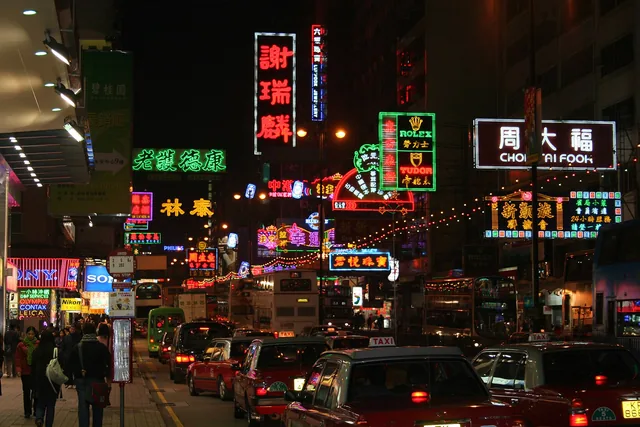
Why Nathan Road, and what is still there to shoot
Nathan Road is the oldest road on the Kowloon Peninsula. Built in 1860 as "Robinson Road", it was renamed "Nathan Road" in 1909, and it runs from the Tsim Sha Tsui waterfront north to Boundary Street (gohk.gov.hk). Sign density is highest in the southern stretch between Tsim Sha Tsui and Mong Kok, and that is where the whole shot list below sits — all of it is walkable in an evening, roughly six MTR stops end to end on the Tsuen Wan Line.
Two pieces of background are worth knowing before you go, because they change what you should expect. Neon arrived in Hong Kong in the 1920s and its use expanded through the 1950s–1980s, with notable concentrations on Nathan Road (West Kowloon Cultural District Authority, "Hong Kong’s neon signs – then and now", on Google Arts & Culture). The trade has since been shrinking, with well-known signs coming down (Coconuts HK, "Neon's dimming legacy"). So read those before you assume the street looks like a 1980s film still, and treat any photograph from 2007 as a historical record rather than a preview. What is left is still dense enough — layered shopfronts, hotel signage, lit building facades and reflected colour on wet asphalt — to fill a night's shooting.
Where to stand: the spot table
Every exit below is the one named by the MTR, the Tourism Commission, or the operator of the building, on the page cited. Street exits put you straight on the pavement; the two elevated options are marked as such. Distances are the ones the source gives.
| Spot | How to reach it (sourced exit) | Best light window | What to shoot | Space and tripod note |
|---|---|---|---|---|
| Tsim Sha Tsui waterfront, outside the Hong Kong Cultural Centre (Salisbury Road) | Tsim Sha Tsui Station, Exit L6 — follow the signs to the waterfront (Tourism Commission, "A Symphony of Lights" FAQ A3) | Late blue hour into dark; timed for the 8:00 p.m. show | The night skyline show itself, plus the live music broadcast on the waterfront | Wide promenade with railings; open enough for a tripod if you keep the railing and the walkway clear |
| Avenue of Stars promenade | East Tsim Sha Tsui Station, Exit J (Tourism Commission, SoL FAQ A3) | From dusk until the crowd thins after the 8:00 p.m. show | Skyline across Victoria Harbour, the Bruce Lee statue, the handprint plaques | Flat, wide walkway; busiest in the half-hour before the show, so arrive early and stay put |
| Clock Tower and 1881 Heritage (Salisbury Road) | East Tsim Sha Tsui Station, Exit L5 — 1881 Heritage is a 6-minute walk (MTR, "Discoveries along Tsim Sha Tsui and East Tsim Sha Tsui Stations") | Blue hour, while there is still colour in the sky behind the lamps | Lit colonial facades and the red-brick Clock Tower against a dusk sky | Forecourt and open pavement; keep clear of the hotel driveways and taxi standing |
| Chungking Mansions block, 36–44 Nathan Road | Tsim Sha Tsui Station, Exit A1 — the exit sits at the junction of Nathan Road and Haiphong Road (MTR media release, 16 January 2014). The mansions' address is 36–44 Nathan Road, Tsim Sha Tsui (Hong Kong Tourism Board) | After dark, once the shopfronts are lit | The classic neon-and-signage canyon; the entrance itself is a strong framing device | The pavement here is narrow and busy; shoot from the wall side and never block the entrance or the touts' patch |
| Nathan Road core: Haiphong Road to Middle Road | Tsim Sha Tsui Station, Exit A1 (Nathan Road / Haiphong Road) or Exit B2 (1-minute walk to the Tsim Sha Tsui fashion shops; MTR discoveries page) | After dark, roughly 7:00–10:00 p.m. when shops are lit | Layered sign density straight down the road; shopfront glow at pavement level | This is the narrowest, busiest stretch in the list — shoot handheld and use a shopfront or wall as a brace rather than planting a tripod |
| K11 MUSEA / Victoria Dockside, 18 Salisbury Road | Tsim Sha Tsui Station, Exit E; or East Tsim Sha Tsui Station, Exit J1 & J2 (K11 MUSEA, "Getting Here") | Blue hour for the facade, then dark for the plaza | Lit museum-retail facade and the harbour-side plaza | Open plaza with room to set a small tripod off the walkways |
| Harbour City, Canton Road — and the Ocean Terminal Deck on its roof | Tsim Sha Tsui Station, Exit A1; East Tsim Sha Tsui Station, Exit L5; or Austin Station, Exit F (Harbour City). The Ocean Terminal Deck is an 11-minute walk from East Tsim Sha Tsui Station Exit L5, or 16 minutes from Tsim Sha Tsui Station Exit A1 (MTR discoveries page) | Dusk for the deck's panorama; after dark for the Canton Road shopfronts | A 270-degree harbour panorama from the deck; the mall's lit frontages from the street | The deck is the one place in this list with genuine elbow room for a tripod; the street below is wall-to-wall people |
| Hong Kong Museum of Art (Salisbury Road) | East Tsim Sha Tsui Station, Exit J — a 7-minute walk (MTR discoveries page) | Blue hour into dark | Lit museum frontage and the waterfront immediately beyond it | Pavement and plaza; busiest when the show lets out |
| Signal Hill Garden (elevated — a short climb off Nathan Road) | Tsim Sha Tsui Station, Exit D2 — a 5-minute walk; or East Tsim Sha Tsui Station, Exit P3 (MTR discoveries page) | Blue hour and the first hour of dark | A raised view back over the Tsim Sha Tsui neon, above head height and above most of the crowd | Path and garden seating; no room for a full tripod setup on the path, so bring a compact one or shoot handheld |
| St Andrew's Church, Nathan Road (Jordan) | Jordan Station, Exit D — a 3-minute walk (MTR, "Discoveries along Yau Ma Tei and Jordan Stations") | Blue hour, while the stained glass still reads from outside | The red-brick church frontage on the street — a colour break from the signage | Pavement; the church is a working building, so keep off the steps and out of the gateway |
| Temple Street Night Market (Yau Ma Tei / Jordan) | Jordan Station, Exit D — a 4-minute walk (MTR discoveries page); or Yau Ma Tei Station, Exit C | After dark until the stalls wind down | Stall lighting, hanging lamps and the canopy of the market — the warm counterpart to Nathan Road's cool signage | Aisles are narrow and full of shoppers; shoot handheld from the edge and keep moving with the flow |
| Mong Kok section and the Argyle Street crossing | Mong Kok Station, Exit B3, Exit C2 or Exit E2 — each is a 2–3 minute walk into the surrounding streets (MTR, "Discoveries along Mong Kok and Prince Edward Stations") | After dark; the crossing is strongest when traffic is stopped and only people fill it | The densest concentration of signage and crowds on the whole road — neon, traffic light trails and people | Overwhelmingly crowded. Shoot handheld, keep your bag in front of you, and expect to be shoulder-to-shoulder |
Two of these are elevated — Signal Hill and the Ocean Terminal Deck — and they earn their place because a street-level shot of neon is exactly what everyone else is already taking. If you only have one night, do the Tsim Sha Tsui waterfront for the 8:00 p.m. show, then walk north through Chungking Mansions and the Nathan Road core; that is the walk that produces both the skyline picture and the street picture.
When to go: blue hour to the 8:00 p.m. show
The light moves through three usable stages. Blue hour — roughly the 30–45 minutes after the sun has gone — is when the sky still holds colour and the signs are already lit, which gives you the contrast that a pitch-black sky cannot. That is the window for facades, the Clock Tower, 1881 Heritage and Signal Hill. Full dark, from about an hour after sunset until shops start closing, is when the neon reaches full intensity against the shopfronts. And 8:00 p.m. sharp is the skyline: "A Symphony of Lights" is staged every night at 8:00 p.m., lasts about ten minutes, and is free (Tourism Commission). Get to the Tsim Sha Tsui waterfront, outside the Hong Kong Cultural Centre, or to the Avenue of Stars, well before eight and stay in position.
One rule matters more than the forecast: the show is suspended if Tropical Cyclone Warning Signal No. 3 or above, or a Red/Black Rainstorm Warning, is issued at or after 3:00 p.m. on the day — and no show is staged even if the signal comes down before 8:00 p.m. (Tourism Commission). So a typhoon-approaching evening is a wasted journey for the skyline shot specifically, however good the neon on the pavement might be.
On crowds: weeknights are noticeably easier than Friday to Sunday, and the earlier you start, the more space you get on the pavement. Weekend evenings on the Mong Kok stretch are a crush, not a vantage point.
Camera and phone settings
These are recommendations, not official settings. The one principle behind all of them: expose for the bright signs, let the dark pavement fall away, and never rely on software to rescue a smeared frame.
| Setting | Phone | Camera |
|---|---|---|
| Mode | Turn night mode off for signage — it fights the neon and adds seconds of handshake. Use the standard photo mode with tap-to-meter on the brightest sign, then drag the exposure slider down. | Manual or aperture priority. Shoot RAW if you have it, so mixed sign colour is recoverable. |
| ISO | Whatever the camera chooses at a locked fast shutter; do not push digital zoom, it destroys the sign edges. | ISO 400–1600 handheld; ISO 100–400 on a tripod. |
| Shutter | Aim for a fast enough frame to stop movement; brace your elbows, or rest the phone on a wall or a bin. | About 1/60–1/125 s handheld; 1–8 s on a tripod for traffic trails and reflections. |
| Aperture | Fixed — ignore it. | f/4–f/8. Wider than f/2.8 on a sign wall can smear the light sources. |
| White balance | Leave auto, or set warm, and fix the mix later. | Manual around 3200–4000 K, or shoot RAW and set it in post. Mixed signage colour is the reason to keep a reference frame. |
| Exposure caution | Meter on the brightest sign, not the dark street. | Protect the highlights: blown neon cannot be recovered, while dark pavement can be lifted. |
Handheld or tripod? Handheld works everywhere on this list and is the only option on the crowded stretches. A tripod buys you clean low-ISO frames and long exposures for traffic trails — worth it on the Tsim Sha Tsui waterfront and the Ocean Terminal Deck, where there is room. On the narrow Nathan Road and Mong Kok pavements, a tripod turned into an obstacle is the fastest way to annoy everyone around you; a compact travel tripod planted against a wall, or just a brace, is the practical compromise.
Rain and reflections
A dry night gives you clean signs on dark asphalt. A night after rain gives you something better: the same signs doubled in the wet road, and coloured puddles doing the framing for you. Shoot low — kneel or crouch — to fill the bottom of the frame with reflection rather than pavement.
What to protect: keep a cloth for the front element and a plastic bag or hood for the body, because a wet lens turns every neon into a smear. Do not step into the road for the reflection shot. Nathan Road traffic does not slow down for photographers, a wet road extends braking distance, and the middle of the carriageway at night is not a vantage point. Shoot from the kerb or the pavement side instead.
Etiquette, safety and legality
- Pavement first. The pavement belongs to everyone walking it. Do not stop dead in the middle of a busy stretch, do not plant a tripod across a walkway, and do not block shop doorways — especially the Chungking Mansions entrance and the market aisles.
- No trespass. Rooftops, private buildings and hotel interiors are not public vantage points. If a view is not accessible from a public street, plaza or an officially open facility, it is not on this list.
- People. You will photograph crowds. Prefer wide shots, in which nobody is identifiable, and if you want a portrait, ask first. Do not chase or corner anyone for a frame.
- Signage and businesses. Photograph the street, not the inside of a shop without permission. A shopfront's signage is part of the streetscape; a shop's interior is not.
- Drones. Do not assume you may fly here. Nothing in this guide depends on a drone, and you should check Hong Kong's current rules and any no-fly restrictions before considering it.
- Weather and water. In a typhoon or a rainstorm warning, stay off the waterfront and out of the exposed decks; the same warning that cancels the show is your cue to move indoors.
Frequently asked questions
What is the best time to shoot Nathan Road neon?
Start at blue hour, about 30–45 minutes after sunset, for facades and a coloured sky; stay through full dark for the signs. If you want the skyline, be on the Tsim Sha Tsui waterfront before 8:00 p.m. for "A Symphony of Lights".
Is a tripod allowed?
There is no general ban on public pavements, but the practical answer is: use one only where there is room — the Tsim Sha Tsui waterfront, the Ocean Terminal Deck, open plazas. On the narrow, crowded stretches of Nathan Road and Mong Kok, shoot handheld; a tripod there is an obstruction.
Does it work on a phone?
Yes, and for most readers it is the better tool. Turn night mode off for signage, tap to meter on the brightest sign, pull the exposure down, and brace the phone against something solid.
Is it safe at night?
The Tsim Sha Tsui to Mong Kok corridor is busy and well lit into the evening. The real risks are traffic — never shoot from the road — and crowding, which is a bag-and-pockets problem rather than a danger.
When is the neon at its best?
Every night, weather permitting; there is no seasonal switch. What changes the picture is rain — a wet road after rain doubles the light in reflections — and how crowded the pavement is, which is heaviest at weekends.
Where next on this site
If the skyline is your target, the Avenue of Stars page covers the promenade itself, and the Chungking Mansions page covers the block at the top of the shot list. For getting around between the spots, see the MTR and Nathan Road transport guide. If the weather turns, Kowloon Park is open late — its outdoor facilities run from 5:00 am to midnight (LCSD) — and if you are planning a night out around a dated event, check the October 2026 events calendar. Image credits and licence details for the photographs on this site are listed on the credits page.
Finally, the pictures on this page are licensed photographs from Wikimedia Commons, and each caption states its source and year; where a photograph is older, it is dated in the caption and is not presented as the street today. Nothing here should be read as a claim that any particular sign is still standing — check before you make a trip for one sign in particular.